
Important: This guide outlines the requirements for Jerusalem. Residents of other municipalities should confirm regulations and payment due dates specific to their locality.
What is Arnona?
Arnona is an annual municipal property tax imposed on the residents of a locality.
 Note
Note
The tax is imposed on the residents of the municipality. Therefore a renter is responsible for paying the tax on a rented property – not the owner.
The amount due is determined based on the size, location and use of the property.
Paying Arnona
The Arnona bill is due at the beginning of each calendar year and must be paid shortly thereafter usually by January 31.
Failure to pay on time can result in interest, legal fees and consequences such as frozen bank accounts. Furthermore, if one was given a discount, it will be canceled at the end of the year if payment has not been made.
Pay the Arnona bill before the due date, even if you have not yet applied for or received a discount. If approved, you will receive a refund to your Israeli bank account or a credit towards the next bill for any overpaid amount.
Note
It is important to file the residence under your name as soon as you move in, as described here. If you pay the bill before registering the residence in your name, any refund due will be issued to whoever was registered as the resident at the time of payment.
How to Pay
The bill may be paid using any of the following ways:
- Post Office (Doar Israel): Present the bill and pay with cash, check or credit card.
- Online: Use an Israeli credit card on the Jerusalem Municipality website.
- Phone: Call 02-629-6000 for automated payment or 02-629-6333 ext. 1 to speak with a representative.
Payment Plans
One can pay the entire bill at the beginning of the year (either before or after filing for a discount). Alternatively, payments may be divided as follows:
- Horaat keva: Monthly automatic withdrawals via bank account. Submit the authorization form signed by your bank to the Arnona office or on the Iriyah’s website. This option offers a 0.75% discount.
- Israeli credit card Installments: No discount; interest may apply from the credit card company.
- Post dated checks: Up to 12 checks dated through December. A detailed receipt will be sent each time a check is deposited. This option incurs interest to be paid to the Arnona office after the last check is processed.
Filing Under Your Name
Entering an Apartment
The person responsible for paying Arnona is called as the machzik.
When someone moves, they must register their residence under their name with the Iriyah (municipality).
Note
Generally, the Iriyah will register the apartment in one’s name only from the date the request is received.
Note
One cannot apply for an Arnona discount unless the apartment is under their name.
 Tip
Tip
Register as the resident (machzik) as soon as possible, even if you plan to apply for a discount at a later date.
Requests to change the resident (machzik) can be submitted online, here.
Note
The apartment’s Property ID Number (mispar neches) is required when completing this form. This number appears on one’s Arnona bill. Israeli citizens can look up their number online. Foreign citizens can call the Iriyah to receive it: 02-629-6333.
Owners: Submit a copy of the purchase contract and photo ID.
Renters: Submit the rental contract and photo ID for both the new tenant and the old one (or the landlord, if applicable).
Once registered, the Arnona office will issue a new bill in your name beginning from your date of entry through the end of the calendar year. Often one must request that a copy of the newly generated bill be sent to them. This can be done by calling the Iriyah at 026296333.
Note
If the previous tenant paid up that year’s bill in full, the remaining balance will be transferred to their new apartment.
Exiting an Apartment
Notify the municipality to remove your name and stop charges when moving out. Submit a request using the same online form as above.
If one is moving within Jerusalem, be sure to register the new apartment as well. The same online form is used.
Arnona Discounts
You may be eligible for a discount (hanacha) of up to 90% if you fall under any of the following categories:
- Disabled
- Low income (see below)
- Sheirut Leumi (National Service)
- Released Soldiers
- Families in urgent need
- Olim Chadashim (new immigrants – see below)
- Recipients of avtachat hachnasa or alimony
- Senior citizens
- Single-parent families
- Owners of new/empty properties
Note
There is no official student discount. However, students may qualify for a low-income discount, as described below.
Income-Based Discount
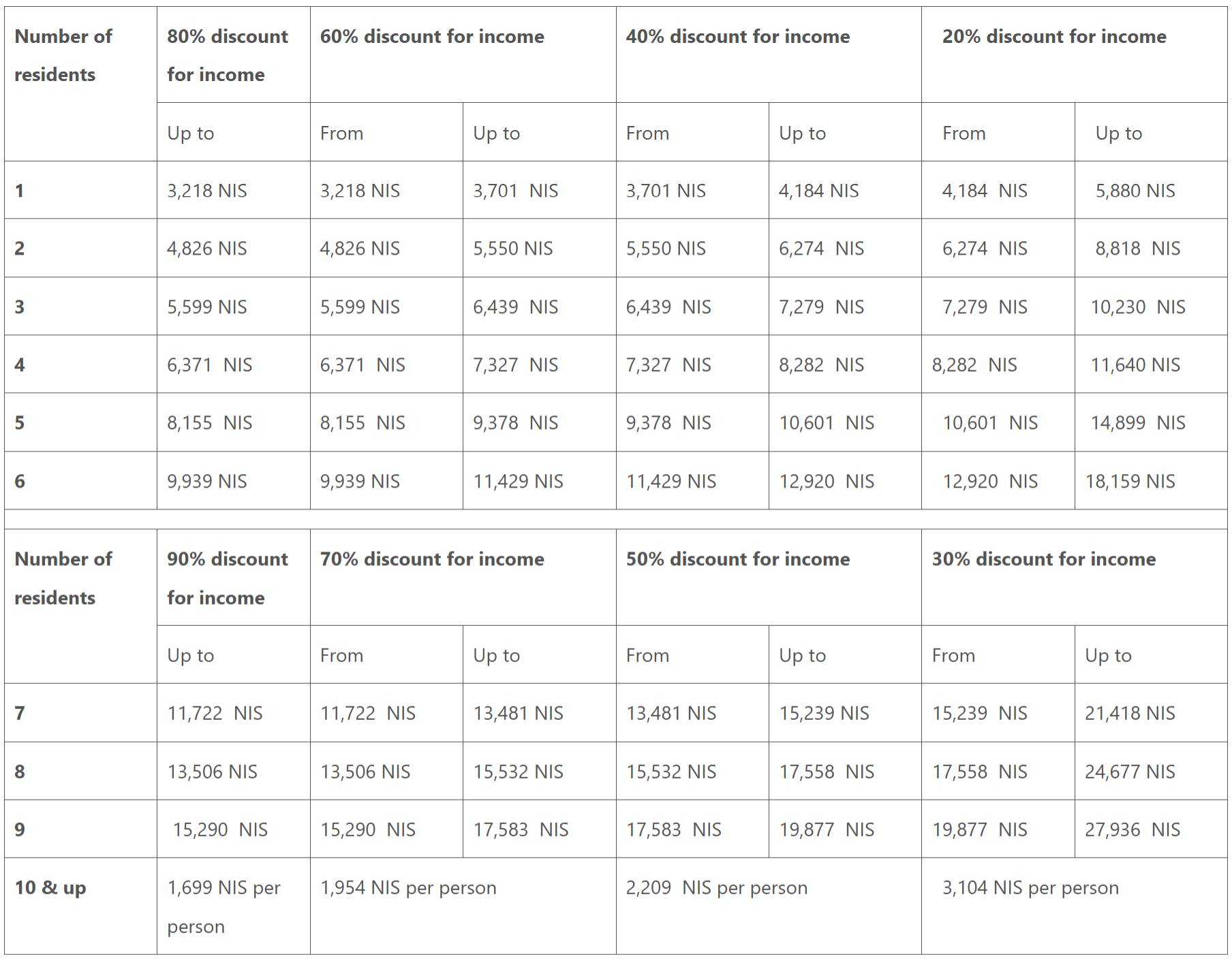
Eligibility for an income-based discount is granted based on the monthly average of income received either during October, November and December of the previous calendar year, or throughout the entire previous calendar year. On the application form, one can select the option that will grant them a greater discount. See the chart below to approximate your eligibility.
- Kollel stipends, income earned abroad and parental support all count as income.
- In apartments up to 120 meters, parental support given directly to the landlord to cover rent is not counted as income. However, in apartments larger than 120 meters, this dispensation does not apply. In such a case, all parental support is considered personal income.
- Certain benefits such as kitzvat yeladim and yeled neche are not counted as income (even though they must be declared). See here for a complete list of what is not counted as income.
- Working children over age 18 living at home: if only one child is working, a salary of less than 5,880 NIS is not calculated as income. If two or more children work, 50% of all children’s full salaries are calculated as part of family income.
A Note on Income-Based Discounts on Large Apartments
An income-based discount may not be granted for residents of very large properties:
Apartments of up to 100 meters are eligible for a low income hanacha if other requirements are met.
For apartments that are between 100 and 160 meters, a discount may be obtained, however it will only be applied to 100 meters of the apartment.
- Exception: families of ten or more are eligible for a hanacha based on family size. An additional hanacha of ten meters per resident can be granted for every additional resident– so a family of eleven can receive a hanacha on 110 meters.
For apartments that are more than 160 meters, no discount is granted unless the family living there has 13 children or more.
When to apply?
Generally, discounts may be applied for starting mid-January. If the discount chart has not yet been published by the Municipality, if one plans on applying for a discount later, or one has not yet been approved for a discount, they are still responsible to set up a payment plan or pay in full at the beginning of the year. See “Paying Arnona” above.
Note
Unpaid balances may lead to interest, legal action or frozen bank accounts. Additionally, discounts can be revoked if dues are not paid by year-end.
If one has not registered their apartment under their name, they must do so before applying for a discount. See “Filing Under Your Name” above.
Note
The deadline to apply for a discount on the year’s bill is October 31. If one entered the apartment after that date, discount applications may be submitted until December 31.
How to apply?
Apply online here. Although one may submit a discount application in person, the Iriyah highly recommends submitting applications online for a smoother processing.
Note
The Arnona office has computers available for public use, where one may apply for the discount via the online form. Service representatives are on hand to answer any questions that may arise while completing the application. The computers are available during regular office hours, see here.
Officially, visa holders are only eligible for discounts during the period of their valid visas. Present renewed visas at the Arnona office so the discount may be applied for the remainder of the year.
Required Documentation
- Teudat zehut or foreign passport with valid A-category visa for all family members. If an Israeli child is not yet listed on a parent’s teudat zehut, submit a copy of the birth certificate.
- Arnona reduction form online. The PDF application form can be found here.
- Rental or purchase contract: rental contract must include the teudat zehut (Israeli ID) numbers or foreign passport numbers of both the renter and the landlord; must be written according to the secular months; and must be current. If it expires before the end of the year, a signed statement of extension must be included. See here for a template of a rental agreement.
- If an adult resident is a salaried worker they must provide tlushim (pay stubs) for either October, November and December of the previous year, or a 106 form for the entire year, depending on which option they chose to be taken into account.
- If the employee earned less than a full-time salary, and/or if there were months that he or she did not work over the accounted period, present an ishur t’kufot bituach u’ma’asikim (also referred to as doch rikuz mekomot avoda) from Bituach Leumi. This document confirms all the individual’s periods of employment.
Print it out either from one’s online Bituach Leumi account or from the self-service machine located in the waiting area of the Arnona office or outside Bituach Leumi’s office on Rechov Shimon Ben Shetach. To use the machine one will need the Bituach Leumi number and four-digit PIN code (also used for the phone system) of the person needing the document. This document can be found under ishurim. - If one received maternity leave for part of the accounted period, include a document from Bituach Leumi that details the amount paid per day of the leave, and tlushim for the rest of the period.
- If the employee earned less than a full-time salary, and/or if there were months that he or she did not work over the accounted period, present an ishur t’kufot bituach u’ma’asikim (also referred to as doch rikuz mekomot avoda) from Bituach Leumi. This document confirms all the individual’s periods of employment.
- If an adult resident is a self-employed worker, they must provide a shumat mas for the previous calendar year.
- For a student, submit an original document from the school, yeshiva, or kollel (on the institution’s official letterhead, including its mispar amuta, non-profit number). This letter must clearly delineate the student’s name, the student’s passport or teudat zehut number, days and hours of study, monthly stipend paid for the previous October, November and December or entire calendar year, and the name, position and ID number of the signer.
- Documentation of any other income, e.g. rent from apartments owned.
- If a resident over age 18 was (1) unemployed and (2) was not a student during October, November and December (or all 12 months) of the previous calendar year:
- If the resident has a teudat zehut or holds a visa that states that they are permitted-to-work, they must also submit an ishur tikufot bituach u’ma’asikim (also referred to as a doch rikuz mekomot avoda) from Bituach Leumi (see #5 above). They may be required to submit an ishur ma’amad lo oveid from Bituach Leumi as well.
- Israeli citizens should also submit an original letter signed by a dayan, judge or lawyer stating that this resident does not work. The letter must include the ID number of the dayan/lawyer who signs it. Visa holders should include this information on the form described here (#11).
- Families with three or more children under age 18 in which the father is a full-time student and the mother does not work –
- If the family receives avtachat hachnasa from Misrad Hachinuch, submit a bank statement from October, November or December of the previous calendar year in which the stipend appears. The statement must include the name and ID number of the account holder.
- If the family does not receive avtachat hachnasa from Misrad Hachinuch, submit bank statements from October, November and December of the previous calendar year. Israeli citizens should also submit a letter from a dayan certifying that (a) the mother does not work and (b) the reason why the family did not receive the pension (e.g. they have already received it for 5 years, etc). Visa holders should include this information in section 14 of the form described in #11 below, here.
- Israeli citizens who do not pay their rent independently must submit an original letter signed by a dayan (judge or lawyer) describing how the rent is paid (e.g. parents pay directly to the landlord). If parents pay the landlord directly, this must be stated explicitly, specifying the method of payment (either “by check” with a copy of the check included or “by cash via a messenger/shaliach”). Visa holders should include this information on the form described in #11 below, here.
In addition, the landlord must provide a letter with his contact information (name, address, cell phone, email), stating via which method he receives the rent money (as above). It is recommended he include the amount being paid.
Note
In the case where one’s rent is greater than their income, a dayan or lawyer’s letter may be required to explain the situation.
Tip
Multiple statements from the dayan can be combined into one letter.
- Families where both spouses are not Israeli citizens must submit this form signed by a dayan (judge or lawyer) along with bank statements. Foreign bank statements must be translated into Hebrew. An English version of the form can be found here.
- If a visa holder has permission to work but is not yet a Bituach Leumi member: include a statement that the applicant is not a Bituach Leumi member in section 14 of the form described in #11 above, here. Additionally, applicants must write in the comments section of the application form that they do not have Bituach Leumi and are therefore unable to provide documentation from them.
- Children over age 18:
- For those who are students, submit an original signed statement from the school with the name and ID number of the child stating that they are studying there.
- For children who are employed, submit tlushim from previous October, November and December.
- For those who received sal klita (absorption stipend from Misrad Haklita) during the previous October, November or December, submit a letter from Misrad Haklita stating this.
- If the household receives havtachat hachnasa (pension), neichut, yeled neiche or any other pension from Bituach Leumi (aside from kitzvat yeladim, zikna and she’airim): present a letter from Bituach Leumi that certifies the amount of the stipend.
Note
Certain benefits such as kitzvat yeladim and yeled neiche are not counted as income, even though they must be declared.
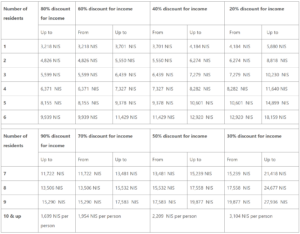
2025 Table of Income-Based Discounts
Note
Discounts for 2025 are based on one’s income in 2024.
| Number of residents | 80% discount for income | 60% discount for income | 40% discount for income | 20% discount for income | |||
| Up to | From | Up to | From | Up to | From | Up to | |
| 1 | 3,218 NIS | 3,218 NIS | 3,701 NIS | 3,701 NIS | 4,184 NIS | 4,184 NIS | 5,880 NIS |
| 2 | 4,826 NIS | 4,826 NIS | 5,550 NIS | 5,550 NIS | 6,274 NIS | 6,274 NIS | 8,818 NIS |
| 3 | 5,599 NIS | 5,599 NIS | 6,439 NIS | 6,439 NIS | 7,279 NIS | 7,279 NIS | 10,230 NIS |
| 4 | 6,371 NIS | 6,371 NIS | 7,327 NIS | 7,327 NIS | 8,282 NIS | 8,282 NIS | 11,640 NIS |
| 5 | 8,155 NIS | 8,155 NIS | 9,378 NIS | 9,378 NIS | 10,601 NIS | 10,601 NIS | 14,899 NIS |
| 6 | 9,939 NIS | 9,939 NIS | 11,429 NIS | 11,429 NIS | 12,920 NIS | 12,920 NIS | 18,159 NIS |
| Number of residents | 90% discount for income | 70% discount for income | 50% discount for income | 30% discount for income | |||
| Up to | From | Up to | From | Up to | From | Up to | |
| 7 | 11,722 NIS | 11,722 NIS | 13,481 NIS | 13,481 NIS | 15,239 NIS | 15,239 NIS | 21,418 NIS |
| 8 | 13,506 NIS | 13,506 NIS | 15,532 NIS | 15,532 NIS | 17,558 NIS | 17,558 NIS | 24,677 NIS |
| 9 | 15,290 NIS | 15,290 NIS | 17,583 NIS | 17,583 NIS | 19,877 NIS | 19,877 NIS | 27,936 NIS |
| 10 & up | 1,699 NIS per person | 1,954 NIS per person | 2,209 NIS per person | 3,104 NIS per person | |||
Discounts for New Immigrants
New immigrants (olim chadashim) can receive a one-time 90% discount on the first 100 meters of their apartment within 24 months of Aliyah.
Note
The immigrant must have a teudat oleh and their name must appear on the Arnona bill.
For further details, see the Iriyah website.
Requesting a Refund
If one already paid in full, is granted a discount and later moves out, they may request to have the difference refunded to their Israeli bank account using this online form. Processing takes approximately three weeks.
Sometimes the overpaid amount will be credited to the next Arnona bill.
Arnona – General Information
Arnona Office, Jerusalem
Kikar Safra 1, 1st floor, Kikar HaIriyah
www.jerusalem.muni.il
Office hours:
Sunday, Monday, Wednesday and Thursday 8:00 am ‒ 1:00 pm
Tuesday 3:00 pm ‒ 6:00 pm
To schedule an appointment:
call *3552 or visit https://tor.jerusalem.muni.il
Operator:
02-629-6333 (answering service in Hebrew)
Sunday ‒ Thursday 8:00 am ‒ 3:30 pm and 4:00 pm ‒ 6:00 pm
Automated telephone service:
02-629-6000 (operates 24 hours a day, except on Shabbos and holidays)
For questions regarding your Arnona discount application, use this online form.
Dayanim
A dayan’s letter is necessary in some cases of low-income discount applications. Here are a few options to explore in Jerusalem. Options are not limited to those included here.
- Badatz Eidah Chareidis, Binyanei Zupnik, Geulah – 02-532-6180
- Beis Din Nesivos Chaim, Panim Meirot 1 (around side of building) – 02-502-3637
- Agudas Yisrael, Yeshayahu Press 2, Geulah (30 NIS fee)
Tip
At times various council members and their staff can assist with Arnona issues.